
SBI vs HDFC vs ICICI Savings Account: Interest Rate, Features & Charges Comparison 2026 – Complete Guide 2026 (India)

Introduction
Opening a savings account is often the first step in a person’s financial journey. Whether you are a student receiving scholarship payments, a salaried professional managing monthly expenses, a freelancer handling client payments, or a retiree saving for the future, choosing the right savings account can make a significant difference.
In India, three banks dominate the savings account market: State Bank of India (SBI), HDFC Bank, and ICICI Bank. These banks serve millions of customers and offer a variety of savings account options with different interest rates, digital banking features, charges, and benefits.
With banking becoming increasingly digital in 2026, customers are no longer looking only at branch networks. They compare mobile banking apps, UPI services, ATM accessibility, account maintenance charges, and customer service before choosing a bank.
This is why many people search for “SBI vs HDFC vs ICICI Savings Account: Interest Rate, Features & Charges Comparison 2026” to determine which bank offers the best overall value.
In this comprehensive guide, we compare SBI, HDFC Bank, and ICICI Bank savings accounts based on interest rates, charges, features, eligibility, digital banking services, and overall customer experience.
What is SBI vs HDFC vs ICICI Savings Account: Interest Rate, Features & Charges Comparison 2026?
This comparison helps customers evaluate the strengths and weaknesses of the three largest banking brands in India.
The comparison focuses on:
- Savings account interest rates
- Minimum balance requirements
- ATM facilities
- Mobile banking experience
- Internet banking features
- Debit card benefits
- Account maintenance charges
- Digital account opening
- Customer support
- Branch and ATM network
Understanding these factors can help customers choose the most suitable savings account based on their financial needs.
Why Do People Search for “SBI vs HDFC vs ICICI Savings Account: Interest Rate, Features & Charges Comparison 2026”?
People compare these banks for several important reasons.
Better Interest Earnings
Customers want to maximize returns on idle funds.
Lower Banking Charges
Many users want accounts with minimal maintenance costs.
Strong Digital Banking
Mobile banking has become a primary banking channel.
Branch Accessibility
Easy access to branches and ATMs remains important.
Premium Banking Benefits
Customers seek additional services such as rewards, insurance, and lifestyle benefits.
SBI vs HDFC vs ICICI Savings Account Overview
| Feature | SBI | HDFC Bank | ICICI Bank |
| Ownership | Public Sector | Private Sector | Private Sector |
| Branch Network | Largest in India | Extensive | Extensive |
| ATM Network | Very Large | Large | Large |
| Digital Banking | Excellent | Excellent | Excellent |
| UPI Support | Yes | Yes | Yes |
| Mobile Banking | Yes | Yes | Yes |
| Internet Banking | Yes | Yes | Yes |
| Online Account Opening | Yes | Yes | Yes |
| Debit Card Facility | Yes | Yes | Yes |
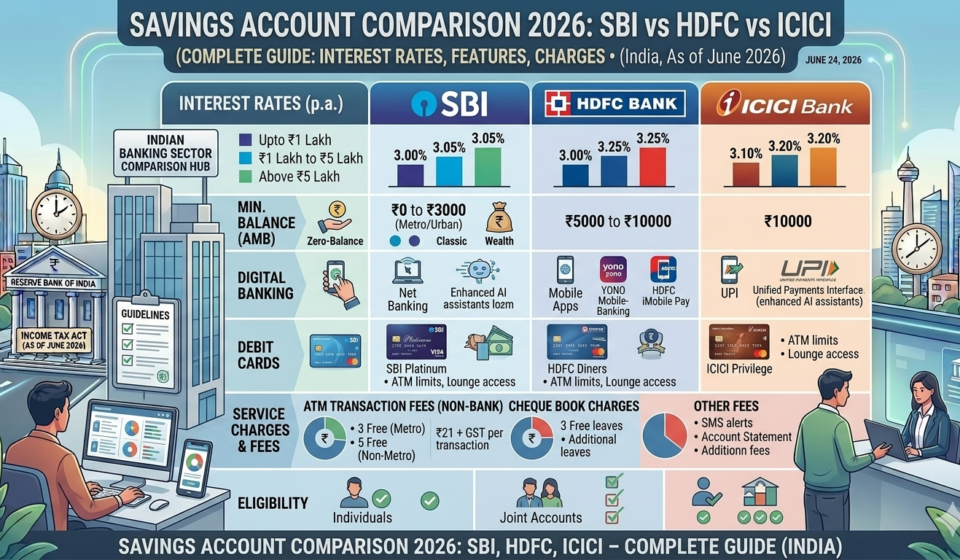
Interest Rate Comparison 2026
One of the most important factors while choosing a savings account is the interest rate.
| Bank | Savings Account Interest Rate (Approx.) |
| SBI | 2.70% p.a. |
| HDFC Bank | 2.75%–3.25% p.a. |
| ICICI Bank | Around 3.00% p.a. |
Interest Rate Winner
For most account holders:
- HDFC Bank often provides competitive rates on higher balances.
- ICICI Bank remains attractive for digital users.
- SBI offers slightly lower rates but compensates through accessibility and lower maintenance requirements.
However, interest rates may change based on RBI policies and individual bank decisions.
How to Open a Savings Account in 2026
1. Visit a Branch
You can open an account by visiting a nearby branch.
Required documents:
- Aadhaar Card
- PAN Card
- Passport-size photograph
- Mobile number
2. Apply Online
Most customers now prefer online account opening.
Steps:
- Visit the bank website.
- Select savings account.
- Enter Aadhaar and PAN details.
- Verify OTP.
- Complete Video KYC.
- Activate account.
3. Use Mobile Banking App
All three banks allow digital onboarding.
Benefits include:
- Instant account opening
- Paperless process
- Faster verification
- Immediate banking access
4. Official Website/App Method
Digital account opening remains the fastest method in 2026.
Advantages:
- No branch visit
- Easy document upload
- Quick KYC verification
- Immediate mobile banking activation
Features and Services Available
Feature 1: UPI Transactions
All three banks support:
- BHIM UPI
- Google Pay
- PhonePe
- Paytm
Customers can make instant money transfers.
Feature 2: Mobile Banking
SBI
YONO SBI offers:
- Banking services
- Investments
- Insurance
- Bill payments
- Card management
HDFC Bank
HDFC Mobile Banking provides:
- Account management
- Fund transfers
- Credit card services
- Investment options
ICICI Bank
iMobile Pay offers:
- Banking
- UPI
- Investments
- Bill payments
- Wealth management
Feature 3: Internet Banking
All banks support:
- NEFT
- RTGS
- IMPS
- Account statements
- Service requests
- Deposit management
Feature 4: ATM and Debit Card Services
Customers can enjoy:
- Cash withdrawals
- Online shopping
- POS transactions
- Contactless payments
Premium account holders may receive additional benefits.
Feature 5: Additional Banking Products
All three banks offer:
- Fixed Deposits
- Recurring Deposits
- Home Loans
- Personal Loans
- Credit Cards
- Insurance Products
Minimum Balance Requirements
Minimum balance requirements vary according to account type and location.
| Bank | General Minimum Balance Requirement |
| SBI | Lower than most private banks |
| HDFC Bank | Higher in metro cities |
| ICICI Bank | Moderate to high depending on account type |
Winner: SBI
SBI generally offers the most customer-friendly balance requirements among the three.
Charges, Fees, or Costs
Before opening an account, customers should understand applicable charges.
Debit Card Replacement Charges
Applicable when cards are lost or damaged.
Additional ATM Withdrawal Charges
May apply after exhausting free monthly transactions.
Cheque Book Charges
Extra cheque books may attract fees.
SMS Alert Charges
Charged according to regulatory guidelines.
Account Closure Charges
May apply if the account is closed shortly after opening.
Detailed Charges Comparison
| Charge Type | SBI | HDFC | ICICI |
| Minimum Balance Penalty | Lower | Higher | Moderate |
| Debit Card Replacement | Applicable | Applicable | Applicable |
| ATM Beyond Free Limit | Applicable | Applicable | Applicable |
| SMS Alerts | Applicable | Applicable | Applicable |
| Cheque Book Extra Leaves | Applicable | Applicable | Applicable |
Charges Winner
For customers seeking lower maintenance costs, SBI generally offers a more economical banking experience.
Types of Savings Accounts Available
Type 1: Regular Savings Account
Suitable for most customers.
Available in all three banks.
Type 2: Zero Balance Savings Account
Designed for students and first-time account holders.
Available through selected account variants.
Type 3: Salary Account
Created specifically for salaried employees.
Benefits often include:
- Zero balance facility
- Higher transaction limits
- Special offers
Type 4: Premium Savings Account
Provides:
- Priority banking
- Enhanced debit cards
- Lifestyle benefits
- Dedicated relationship managers
Benefits of SBI Savings Account
Benefit 1
Largest branch network in India.
Benefit 2
Strong rural and semi-urban presence.
Benefit 3
Lower balance requirements.
Benefit 4
Government-backed trust.
Benefit 5
Extensive ATM network.
Benefits of HDFC Savings Account
Benefit 1
Excellent customer service.
Benefit 2
Premium banking experience.
Benefit 3
Advanced digital banking.
Benefit 4
Fast account opening.
Benefit 5
Wide range of account variants.
Benefits of ICICI Savings Account
Benefit 1
Strong digital ecosystem.
Benefit 2
User-friendly mobile banking.
Benefit 3
Competitive interest rates.
Benefit 4
Fast online banking services.
Benefit 5
Multiple account choices.
Safety Tips and Best Practices
When using a savings account:
- Never share OTPs.
- Keep ATM PIN confidential.
- Enable SMS alerts.
- Use strong passwords.
- Avoid suspicious links.
- Update mobile banking apps regularly.
- Monitor account activity frequently.
Common Problems and Solutions
Problem 1: ATM Transaction Failed
Solution: Check transaction status and contact customer support.
Problem 2: Mobile Banking Login Issues
Solution: Reset credentials using registered mobile number.
Problem 3: UPI Not Working
Solution: Re-register bank account in the UPI application.
Problem 4: Debit Card Blocked
Solution: Unblock through mobile banking or customer care.
Problem 5: KYC Not Updated
Solution: Complete Aadhaar and PAN verification.
What to Do If Something Goes Wrong?
Step 1
Check account statement and transaction records.
Step 2
Review SMS and email notifications.
Step 3
Contact customer support.
Step 4
Raise an online complaint.
Step 5
Visit your branch if necessary.
Step 6
Escalate unresolved issues to the bank’s grievance officer.
SBI vs HDFC vs ICICI Savings Account vs Alternatives
| Feature | SBI | HDFC | ICICI | Small Finance Banks |
| Branch Network | Excellent | Very Good | Very Good | Limited |
| ATM Coverage | Excellent | Very Good | Very Good | Limited |
| Digital Banking | Excellent | Excellent | Excellent | |
| Interest Rate | Moderate | Good | Good | |
| Minimum Balance | Lower | Higher | Moderate | |
| Customer Support | Good | Very Good | Very Good |
Detailed Comparison
If your priority is branch access, trust, and lower balance requirements, SBI remains a strong choice.
If you value premium customer service and advanced banking features, HDFC Bank stands out.
If you prefer a highly digital banking experience with strong mobile banking capabilities, ICICI Bank is an excellent option.
For customers looking solely for higher interest rates, some Small Finance Banks may offer better returns, but they usually have fewer branches and ATMs.
Frequently Asked Questions (FAQs)
1. Which bank offers the highest savings account interest rate in 2026?
Among SBI, HDFC, and ICICI, HDFC and ICICI generally offer slightly higher rates depending on account balance and account type.
2. Which bank is best for students?
SBI is often preferred due to its lower balance requirements and extensive branch network.
3. Which bank has the best mobile banking app?
YONO SBI, HDFC Mobile Banking, and iMobile Pay are all strong options, though many users consider iMobile Pay highly feature-rich.
4. Can I open these savings accounts online?
Yes. All three banks offer online account opening with Video KYC.
5. Which bank has the largest ATM network?
SBI operates one of the largest ATM and branch networks in India.
6. Which bank is best for salary accounts?
HDFC and ICICI are widely used by corporate employers, while SBI also offers competitive salary account benefits.
7. Are SBI, HDFC, and ICICI savings accounts safe?
Yes. All three banks are regulated by the Reserve Bank of India (RBI) and are considered safe for customer deposits.
Conclusion
Choosing between SBI, HDFC, and ICICI Savings Accounts in 2026 depends on your banking habits, financial goals, and service expectations.
Choose SBI if you want lower maintenance requirements, extensive branch coverage, and strong nationwide accessibility.
Choose HDFC Bank if you prefer premium banking services, excellent customer support, and advanced account features.
Choose ICICI Bank if digital banking, mobile app experience, and online convenience are your priorities.
All three banks offer secure, reliable, and feature-rich savings accounts. Before opening an account, compare the latest interest rates, minimum balance requirements, debit card benefits, and service charges to select the account that best suits your needs in 2026.