
Savings Account Mein Kitna Paisa Rakh Sakte Hain? Income Tax & RBI Rules Explained – Complete Guide 2026 (India)

Introduction
Many bank customers in India often wonder, “Savings Account Mein Kitna Paisa Rakh Sakte Hain?” This question becomes especially important when people receive a large salary, sell a property, inherit money, receive business payments, or accumulate substantial savings over time.
A common misconception is that the Reserve Bank of India (RBI) has fixed a maximum limit on how much money can be kept in a savings account. Others worry that keeping a large amount in their account may automatically attract Income Tax scrutiny.
The truth is more nuanced. While there is generally no RBI-imposed maximum balance limit for most savings accounts, there are important Income Tax reporting rules, cash transaction regulations, and compliance requirements that every account holder should understand.
In this detailed guide, we explain RBI guidelines, Income Tax rules, reporting thresholds, taxation aspects, and best practices for managing large balances in a savings account in India in 2026.
What is Savings Account Mein Kitna Paisa Rakh Sakte Hain?
A savings account is a deposit account offered by banks that allows customers to:
- Deposit money
- Withdraw funds
- Earn interest
- Make digital payments
- Receive salaries
- Transfer money
One of the most frequently asked questions is whether there is any maximum balance limit.
Simple Answer
For most savings accounts in India:
There is generally no fixed maximum amount that you can keep in a savings account.
However, banks and tax authorities may monitor large transactions to ensure compliance with financial regulations.
Why Do People Search for “Savings Account Mein Kitna Paisa Rakh Sakte Hain?”
People search for this topic for various reasons.
Salary Growth
High-income professionals often accumulate significant savings.
Property Sales
Large amounts may be credited after selling real estate.
Business Receipts
Some freelancers and professionals temporarily hold funds in savings accounts.
Tax Concerns
People want to avoid Income Tax notices.
Banking Safety
Customers want to know whether keeping large balances is safe.
RBI Rules: Is There Any Maximum Limit?
One of the biggest myths is that RBI restricts the maximum balance in a savings account.
Reality
The RBI does not generally specify a maximum amount that an individual can keep in a regular savings account.
You can legally maintain:
- ₹1 lakh
- ₹5 lakh
- ₹10 lakh
- ₹50 lakh
- ₹1 crore or more
provided the source of funds is legitimate and properly documented.
What RBI Focuses On
RBI regulations primarily focus on:
- KYC compliance
- Anti-money laundering rules
- Suspicious transaction monitoring
- Banking transparency
- Financial system integrity
Banks may ask for additional information if unusually large transactions occur.
Income Tax Rules Explained
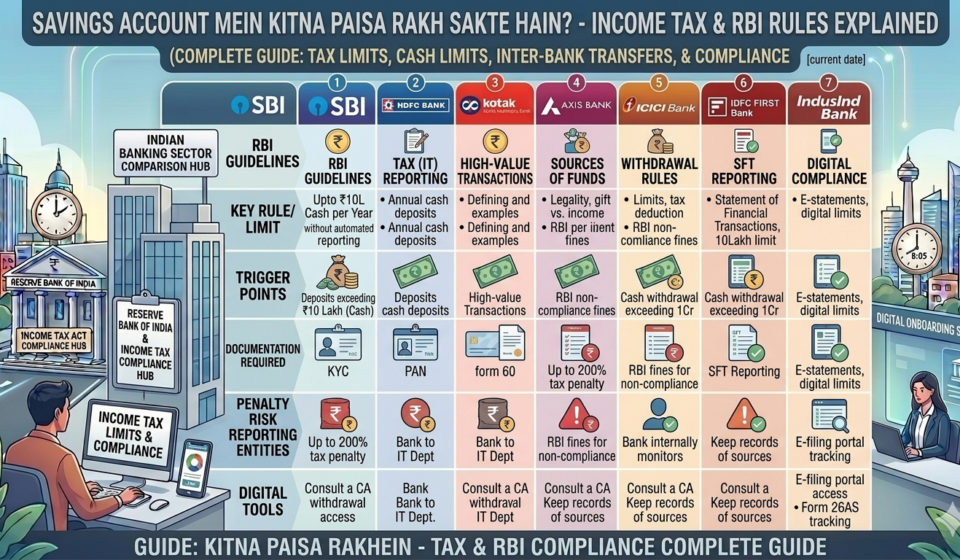
Although there is usually no maximum balance limit, Income Tax rules become important when large deposits or transactions occur.
Annual Information Statement (AIS)
Banks report certain high-value transactions to the Income Tax Department.
This helps authorities verify whether transactions match a taxpayer’s declared income.
Large Cash Deposit Reporting
Banks may report substantial cash deposits under regulatory requirements.
Examples include:
- Frequent large cash deposits
- Unusual account activity
- Transactions inconsistent with customer profile
This does not automatically mean a tax problem exists.
However, customers should be able to explain the source of funds.
Source of Funds Matters More Than Balance
Income Tax authorities are generally more concerned about:
- Where money came from
- Whether taxes were paid
- Whether income was disclosed properly
than the actual balance maintained in the account.
How to Manage Large Savings Account Balances in 2026
1. Maintain Proper Documentation
Keep records for:
- Salary income
- Business income
- Property sale proceeds
- Inheritance
- Investments redeemed
- Gifts received
Documentation helps if clarification is ever required.
2. File Income Tax Returns Regularly
Timely filing of Income Tax Returns (ITR) demonstrates financial transparency.
This reduces potential compliance issues.
3. Use Banking Channels
Whenever possible, use:
- NEFT
- RTGS
- IMPS
- UPI
- Cheques
instead of large cash transactions.
4. Official Banking Method
Use official banking channels for large transactions.
Advantages include:
- Better transaction records
- Easier tax compliance
- Improved financial transparency
- Lower regulatory concerns
Features and Services Available for High-Balance Customers
Feature 1: Interest Earnings
Savings accounts continue earning interest regardless of balance size.
Feature 2: Digital Banking
Customers can manage large balances through:
- Mobile banking
- Internet banking
- UPI
Feature 3: Investment Options
Banks allow easy transfer of funds into:
- Fixed Deposits
- Recurring Deposits
- Mutual Funds
- Bonds
Feature 4: Premium Banking
Higher balances may qualify customers for:
- Priority banking
- Dedicated relationship managers
- Special service privileges
Feature 5: Fund Transfers
Large transfers can be executed using:
- RTGS
- NEFT
- IMPS
subject to bank limits.
Limits, Eligibility, or Requirements
To maintain large balances comfortably:
Valid KYC
Your account should have:
- Aadhaar
- PAN
- Address proof
- Updated mobile number
PAN Compliance
PAN becomes particularly important for high-value financial transactions.
Tax Compliance
Maintain proper tax records for income sources.
Charges, Fees, or Costs
Keeping a high balance generally does not attract additional charges.
However, customers should consider:
Minimum Balance Rules
Applicable in regular savings accounts.
Fund Transfer Charges
Some special transfers may have associated fees.
Debit Card Charges
Premium cards may have annual fees.
SMS Alert Charges
May apply according to regulatory guidelines.
Types of Savings Account Balances
Type 1: Regular Savings Balance
Typical balance maintained for daily banking.
Type 2: Emergency Fund Balance
Funds reserved for emergencies.
Type 3: Temporary High Balance
Money received from:
- Property sale
- Bonus
- Business transaction
and temporarily parked in the account.
Type 4: Long-Term High Balance
Large savings maintained over an extended period.
Benefits of Keeping Money in a Savings Account
Benefit 1: Liquidity
Funds are available whenever needed.
Benefit 2: Safety
Bank deposits offer a high level of security.
Benefit 3: Interest Income
Balances earn interest.
Benefit 4: Digital Access
Money can be accessed through various banking channels.
Benefit 5: Easy Transfers
Customers can transfer funds instantly.
Safety Tips and Best Practices
If you maintain large balances:
Use Strong Passwords
Protect internet banking accounts.
Enable Transaction Alerts
Monitor account activity in real time.
Avoid Sharing OTPs
Never disclose OTPs to anyone.
Use Official Banking Apps
Avoid unofficial applications.
Diversify Large Funds
Consider spreading funds across suitable financial products.
Common Problems and Solutions
Problem 1: Income Tax Notice
Solution: Maintain records showing the source of funds.
Problem 2: Account Freeze Due to KYC Issues
Solution: Update KYC immediately.
Problem 3: Suspicious Transaction Inquiry
Solution: Provide supporting documentation.
Problem 4: Large Transfer Delay
Solution: Contact the bank and verify transfer limits.
Problem 5: Low Interest Earnings
Solution: Consider transferring surplus funds into FDs or other suitable investment options.
What to Do If Something Goes Wrong?
Step 1
Review transaction history.
Step 2
Collect supporting documents.
Step 3
Contact the bank.
Step 4
Respond promptly to any compliance requests.
Step 5
Consult a tax professional if necessary.
Step 6
Keep all records safely for future reference.
Savings Account vs Fixed Deposit
| Feature | Savings Account | Fixed Deposit |
| Liquidity | High | Lower |
| Interest Rate | Lower | Higher |
| Withdrawal Flexibility | Anytime | Restricted |
| Emergency Access | Excellent | Moderate |
| Long-Term Growth | Limited | Better |
| Suitable for Daily Use | Yes | No |
Detailed Comparison
A savings account is ideal for maintaining liquidity and handling daily transactions. However, keeping very large balances in a savings account for extended periods may not be the most efficient strategy because savings account interest rates are generally lower than fixed deposit rates.
Many financial experts recommend maintaining an emergency fund and operational cash in a savings account while investing surplus funds in suitable financial instruments.
Frequently Asked Questions (FAQs)
1. Savings account mein maximum kitna paisa rakh sakte hain?
Generally, there is no fixed RBI-imposed maximum balance limit for most savings accounts. The source of funds should be legitimate and properly documented.
2. Kya ₹10 lakh savings account mein rakh sakte hain?
Yes. You can legally maintain ₹10 lakh or more if the funds are from valid sources.
3. Kya ₹50 lakh savings account mein rakhna allowed hai?
Yes. There is usually no restriction on maintaining ₹50 lakh if proper documentation exists.
4. Kya Income Tax Department savings account monitor karta hai?
Certain high-value transactions may be reported under regulatory requirements, but ordinary customers need not worry if their income and transactions are properly disclosed.
5. Kya large balance par tax lagta hai?
The balance itself is not taxed. However, interest earned and the source of funds may have tax implications.
6. Kya RBI savings account balance limit fix karta hai?
Generally, RBI does not prescribe a maximum balance limit for regular savings accounts.
7. Kya savings account mein ₹1 crore rakh sakte hain?
Yes. There is generally no prohibition on maintaining ₹1 crore or more if the funds are legal and properly documented.
Conclusion
The answer to “Savings Account Mein Kitna Paisa Rakh Sakte Hain? Income Tax & RBI Rules Explained” is straightforward: there is generally no fixed maximum balance limit imposed by RBI on regular savings accounts in India.
However, maintaining large balances comes with responsibilities. Customers should ensure proper KYC compliance, maintain records of income sources, file Income Tax returns accurately, and avoid unexplained cash transactions.
The most important factor is not how much money you keep in your savings account, but whether you can explain where that money came from if required.
For long-term wealth creation, it is often wise to keep only the necessary amount in a savings account and invest surplus funds in suitable options such as fixed deposits, mutual funds, bonds, or other investments based on your financial goals.
By understanding RBI guidelines, Income Tax reporting requirements, and good banking practices, you can confidently manage your savings account balance in 2026 and beyond.