
Savings Account Interest Pe Tax Lagta Hai? Section 80TTA Complete Guide – Complete Guide 2026 (India)

Introduction
Many people believe that the interest earned from a savings account is completely tax-free. However, this is only partially true. While savings account interest enjoys certain tax benefits under the Income Tax Act, it is not entirely exempt from taxation.
Whether you maintain a savings account with SBI, HDFC Bank, ICICI Bank, Axis Bank, PNB, Bank of Baroda, or any other bank, the interest earned on your savings balance is considered income and may be taxable depending on your total earnings and applicable deductions.
To provide relief to small taxpayers, the Income Tax Act includes Section 80TTA, which allows eligible individuals to claim a deduction on savings account interest income.
This is why many people search for “Savings Account Interest Pe Tax Lagta Hai? Section 80TTA Complete Guide” to understand how much tax applies, who can claim deductions, and how to report savings account interest while filing Income Tax Returns (ITR).
This comprehensive guide explains savings account interest taxation, Section 80TTA benefits, eligibility, limits, examples, calculations, and frequently asked questions for Financial Year 2025-26 and Assessment Year 2026-27.
What is Savings Account Interest?
Savings account interest is the amount paid by banks on the balance maintained in your savings account.
For example:
If your bank offers 3% annual interest and you maintain an average balance of ₹1,00,000, the bank may credit approximately ₹3,000 as interest over a year (subject to bank calculation methods).
This interest becomes part of your income.
Is Savings Account Interest Taxable?
Short Answer: Yes
Interest earned from a savings account is considered taxable income under the Income Tax Act.
However, eligible taxpayers may claim deductions under Section 80TTA or Section 80TTB (for senior citizens).
Why Do People Search for “Savings Account Interest Pe Tax Lagta Hai?”
People commonly search for this topic because:
Income Tax Return Filing
Taxpayers want to know whether savings account interest must be reported.
Tax Saving Opportunities
Many people want to claim available deductions.
Multiple Bank Accounts
Interest may be earned from several accounts.
Tax Notices
People want to avoid mistakes while filing ITR.
Senior Citizen Benefits
Retirees want to understand special deduction rules.
What is Section 80TTA?
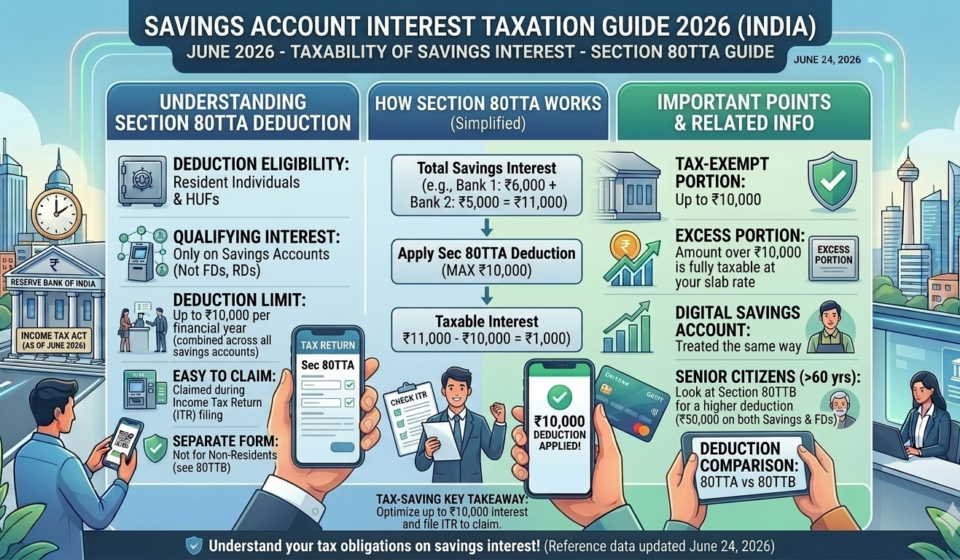
Section 80TTA is a provision under the Income Tax Act that provides a deduction on interest earned from savings accounts.
Deduction Available
Up to ₹10,000 per financial year.
Eligible Interest Sources
- Savings accounts with banks
- Savings accounts with cooperative banks
- Savings accounts with post offices
Who Can Claim Section 80TTA?
Eligible taxpayers include:
Resident Individuals
Most individual taxpayers can claim the deduction.
Hindu Undivided Families (HUFs)
HUFs are also eligible.
Who Cannot Claim Section 80TTA?
Senior Citizens
Senior citizens generally claim benefits under Section 80TTB instead.
Companies
Not eligible.
Partnership Firms
Not eligible.
How Does Section 80TTA Work?
Example 1
Suppose:
- Savings Account Interest = ₹6,000
Deduction under Section 80TTA = ₹6,000
Taxable Interest = ₹0
Example 2
Suppose:
- Savings Account Interest = ₹10,000
Deduction = ₹10,000
Taxable Interest = ₹0
Example 3
Suppose:
- Savings Account Interest = ₹18,000
Deduction = ₹10,000
Taxable Interest = ₹8,000
Only the excess amount becomes taxable.
How to Calculate Savings Account Interest Tax in 2026
1. Calculate Total Interest Earned
Add interest from all savings accounts.
Example:
- SBI = ₹4,000
- HDFC = ₹3,500
- ICICI = ₹2,500
Total Interest = ₹10,000
2. Apply Section 80TTA Deduction
Maximum deduction allowed:
₹10,000
3. Determine Taxable Interest
If total interest exceeds ₹10,000:
Taxable Amount = Total Interest − Deduction
4. Include in Income Tax Return
Report interest income while filing ITR.
Official Method to Claim Section 80TTA
Step 1
Collect interest certificates or account statements.
Step 2
Calculate total savings account interest.
Step 3
Include interest under “Income from Other Sources.”
Step 4
Claim deduction under Section 80TTA.
Step 5
Verify deduction before submitting ITR.
Features and Benefits of Section 80TTA
Feature 1: Tax Relief
Provides deduction up to ₹10,000.
Feature 2: Encourages Savings
Rewards individuals who save money in bank accounts.
Feature 3: Applicable Across Banks
Works for multiple savings accounts.
Feature 4: Easy to Claim
Can be claimed directly in the ITR.
Feature 5: Reduces Taxable Income
Lowers overall tax liability.
Limits, Eligibility, and Requirements
Maximum Deduction
₹10,000 per financial year.
Applicable Only on Savings Accounts
Not available for:
- Fixed Deposits (FDs)
- Recurring Deposits (RDs)
- Corporate Deposits
Valid PAN
Required for tax compliance.
Proper Income Reporting
Interest income must be declared.
Charges, Fees, or Costs
There is no fee to claim Section 80TTA.
However:
Incorrect Reporting
May result in tax notices.
Underreporting Income
Can attract penalties and interest.
Filing Errors
May require revised returns.
Types of Interest Income
Type 1: Savings Account Interest
Eligible under Section 80TTA.
Type 2: Fixed Deposit Interest
Not eligible under Section 80TTA.
Type 3: Recurring Deposit Interest
Not eligible under Section 80TTA.
Type 4: Post Office Savings Interest
Eligible under applicable conditions.
Section 80TTA vs Section 80TTB
| Feature | Section 80TTA | Section 80TTB |
| Eligible Taxpayer | Individuals & HUFs | Senior Citizens |
| Maximum Deduction | ₹10,000 | ₹50,000 |
| Savings Account Interest | Covered | Covered |
| FD Interest | Not Covered | Covered |
| RD Interest | Not Covered | Covered |
| Best For | Non-Senior Citizens | Senior Citizens |
Detailed Comparison
Section 80TTA benefits non-senior citizens by providing a deduction of up to ₹10,000 on savings account interest.
Section 80TTB provides much greater benefits for senior citizens, allowing deductions up to ₹50,000 on various forms of interest income, including savings accounts and fixed deposits.
Benefits of Claiming Section 80TTA
Benefit 1: Lower Tax Liability
Reduces taxable income.
Benefit 2: Simple Compliance
Easy to claim during ITR filing.
Benefit 3: Encourages Banking
Promotes formal savings.
Benefit 4: Supports Small Savers
Provides relief to ordinary taxpayers.
Benefit 5: Available Every Year
Can be claimed annually if eligible.
Safety Tips and Best Practices
Maintain Interest Records
Keep annual interest statements.
Check AIS Regularly
Verify income details in your tax records.
Report All Interest Income
Even if eligible for deduction.
Avoid Underreporting
Declare income accurately.
Consult a Tax Professional
If you have multiple income sources.
Common Problems and Solutions
Problem 1: Forgot to Report Interest
Solution: File a revised return if permitted.
Problem 2: Deduction Not Claimed
Solution: Review and revise ITR if eligible.
Problem 3: Multiple Savings Accounts
Solution: Add interest from all accounts before claiming deduction.
Problem 4: Confusion Between FD and Savings Interest
Solution: Remember that Section 80TTA applies only to savings account interest.
Problem 5: Tax Notice Received
Solution: Provide accurate income records and supporting documents.
What to Do If Something Goes Wrong?
Step 1
Download interest certificates from banks.
Step 2
Compare with AIS information.
Step 3
Verify tax return details.
Step 4
Correct any reporting errors.
Step 5
Respond promptly to tax communications.
Step 6
Seek professional assistance if needed.
Frequently Asked Questions (FAQs)
1. Kya savings account interest taxable hota hai?
Yes. Savings account interest is taxable, but eligible taxpayers can claim deductions under Section 80TTA.
2. Section 80TTA mein kitni deduction milti hai?
A maximum deduction of ₹10,000 per financial year is available to eligible taxpayers.
3. Kya FD interest par Section 80TTA milta hai?
No. Fixed Deposit interest is not eligible under Section 80TTA.
4. Kya multiple bank accounts ka interest add karna padta hai?
Yes. Interest from all savings accounts must be added together.
5. Senior citizens ko Section 80TTA milta hai?
Generally, senior citizens claim benefits under Section 80TTB instead.
6. Kya savings account interest ITR mein show karna zaroori hai?
Yes. Interest income should be reported while filing Income Tax Returns.
7. Agar savings account interest ₹8,000 hai to tax lagega?
If you are eligible for Section 80TTA, the entire ₹8,000 may be deductible, resulting in no taxable savings account interest.
Conclusion
The answer to “Savings Account Interest Pe Tax Lagta Hai?” is yes—savings account interest is considered taxable income under the Income Tax Act. However, eligible individuals and HUFs can claim a deduction of up to ₹10,000 under Section 80TTA, significantly reducing or even eliminating the taxable portion of their savings account interest.
The key points to remember are:
- Savings account interest is taxable.
- Section 80TTA offers a deduction up to ₹10,000.
- FD and RD interest are not covered under Section 80TTA.
- Interest from all savings accounts must be combined.
- Proper reporting in the Income Tax Return is essential.
By understanding Section 80TTA and maintaining accurate records, taxpayers can remain compliant while taking full advantage of the tax benefits available on savings account interest in 2026.