
Best Savings Account Interest Rate India June 2026 — All Banks Updated List – Complete Guide 2026 (India)

Introduction
When choosing a savings account, most people focus on ATM facilities, mobile banking, and branch availability. However, one factor that can significantly impact your earnings over time is the savings account interest rate.
Although savings accounts are primarily meant for liquidity and daily banking needs, the interest earned on your balance can help grow your money. A difference of even 1–2% in interest rates can result in thousands of rupees of additional earnings annually, especially if you maintain a large balance.
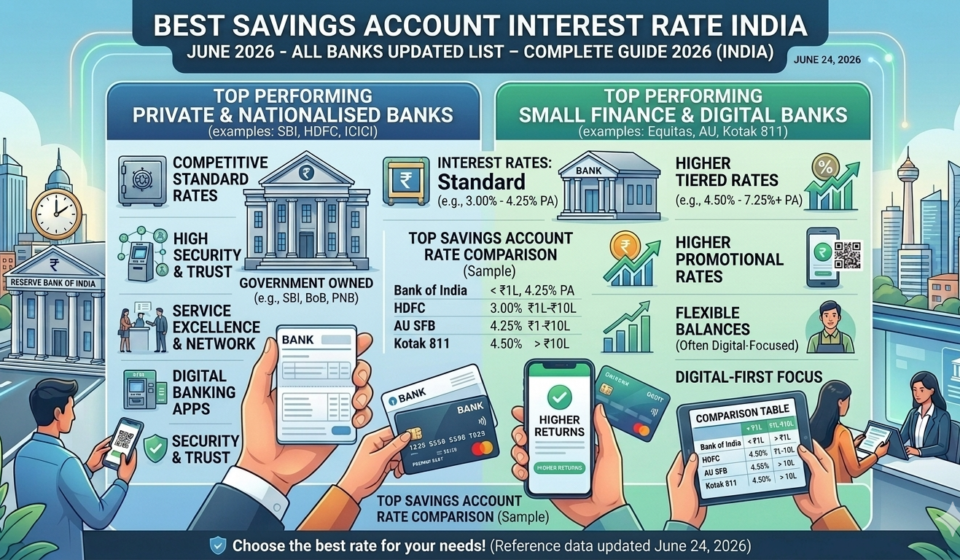
In June 2026, Indian banks continue to offer varying savings account interest rates. While major banks such as SBI, HDFC Bank, ICICI Bank, and PNB offer relatively modest rates, several Small Finance Banks provide significantly higher returns.
This guide provides a comprehensive comparison of the Best Savings Account Interest Rate India June 2026, helping you identify which banks offer the highest rates, what conditions apply, and how to choose the right savings account for your needs.
What is a Savings Account Interest Rate?
A savings account interest rate is the percentage a bank pays annually on the balance maintained in your account.
Example
Suppose:
- Account Balance: ₹1,00,000
- Interest Rate: 3% per annum
Annual Interest Earned:
₹1,00,000 × 3% = ₹3,000
Banks generally calculate interest on the daily closing balance and credit it quarterly or periodically according to their policy.
Why Do People Search for “Best Savings Account Interest Rate India June 2026”?
People compare savings account interest rates for various reasons:
Higher Returns
Earn more on idle cash.
Emergency Fund Storage
Keep emergency savings accessible while earning interest.
Better Banking Value
Maximize returns without locking money into fixed deposits.
Large Savings Balances
High balances benefit more from higher interest rates.
Digital Banking Options
Many high-interest banks now offer fully digital accounts.
Best Savings Account Interest Rate India June 2026 – Updated List
Major Public and Private Sector Banks
| Bank | Savings Interest Rate (Approx.) |
| SBI | 2.70% p.a. |
| HDFC Bank | 2.75%–3.25% p.a. |
| ICICI Bank | Around 3.00% p.a. |
| Axis Bank | Around 3.00% p.a. |
| Kotak Mahindra Bank | Around 3.00%–3.50% p.a. |
| PNB | Around 2.70%–3.00% p.a. |
| Bank of Baroda | Around 2.75%–3.00% p.a. |
| Canara Bank | Around 2.90%–3.00% p.a. |
| Union Bank of India | Around 2.75%–3.00% p.a. |
| Indian Bank | Around 2.75%–3.00% p.a. |
Small Finance Banks Offering Higher Rates
| Bank | Savings Interest Rate (Approx.) |
| AU Small Finance Bank | Up to 7%+ p.a. |
| Equitas Small Finance Bank | Up to 7%+ p.a. |
| Ujjivan Small Finance Bank | Up to 7%+ p.a. |
| Jana Small Finance Bank | Up to 7%+ p.a. |
| ESAF Small Finance Bank | Up to 7%+ p.a. |
| Suryoday Small Finance Bank | Up to 8%+ p.a. |
| Utkarsh Small Finance Bank | Up to 7%+ p.a. |
Note: Interest rates may vary depending on account balance slabs and bank policy updates.
Which Bank Offers the Highest Savings Account Interest Rate in June 2026?
Among mainstream banks:
Top Private Sector Options
- Kotak Mahindra Bank
- HDFC Bank
- ICICI Bank
Among Small Finance Banks:
Top High-Interest Options
- Suryoday Small Finance Bank
- AU Small Finance Bank
- Ujjivan Small Finance Bank
- Equitas Small Finance Bank
These banks may offer rates significantly higher than traditional banks.
How to Find and Compare Savings Account Interest Rates in 2026
1. Visit Official Bank Websites
Banks regularly update interest rates.
Check:
- Savings account pages
- Interest rate schedules
- Deposit product pages
2. Compare Account Types
Different savings accounts may have different rates.
Examples:
- Regular Savings Account
- Premium Savings Account
- Salary Account
- Senior Citizen Account
3. Check Balance Slabs
Many banks offer:
- Lower rates for smaller balances
- Higher rates for larger balances
Always review slab-based pricing.
4. Official Website/App Method
The safest way to verify rates is through official bank websites or mobile banking apps.
Benefits:
- Accurate information
- Latest updates
- Product-specific rates
Features and Services Available
Feature 1: ATM and Debit Card
Most savings accounts include:
- ATM withdrawals
- Online transactions
- Contactless payments
Feature 2: Mobile Banking
Modern accounts support:
- UPI
- Fund transfers
- Bill payments
Feature 3: Internet Banking
Customers can:
- View statements
- Open deposits
- Transfer funds
Feature 4: Digital Account Opening
Many banks offer:
- Video KYC
- Paperless onboarding
Feature 5: Interest Earnings
Balances earn periodic interest based on bank rates.
Factors to Consider Beyond Interest Rates
A higher interest rate is attractive, but it should not be the only factor.
Branch Network
Large banks provide wider accessibility.
Customer Service
Service quality varies between banks.
Mobile Banking Experience
Digital convenience matters in 2026.
ATM Availability
Consider nearby ATM access.
Safety and Reputation
Choose regulated and trusted institutions.
Limits, Eligibility, or Requirements
To open a savings account:
Age Requirement
Generally 18 years or older.
KYC Documents
Usually:
- Aadhaar Card
- PAN Card
- Address Proof
Mobile Number
Required for OTP and alerts.
Minimum Balance
Depends on account type.
Charges, Fees, or Costs
Before selecting a bank, review:
Minimum Balance Charges
Applicable in many accounts.
Debit Card Fees
Some premium cards carry annual charges.
SMS Alert Charges
May apply under regulatory guidelines.
ATM Transaction Charges
Beyond free transaction limits.
Cheque Book Charges
Additional cheque books may incur fees.
Types of Savings Accounts
Type 1: Regular Savings Account
Suitable for most individuals.
Type 2: Zero Balance Savings Account
No minimum balance requirement.
Type 3: Salary Account
Designed for salaried employees.
Type 4: Premium Savings Account
Provides enhanced benefits and services.
Benefits of High-Interest Savings Accounts
Benefit 1: Better Returns
Earn more on idle cash.
Benefit 2: Liquidity
Money remains accessible.
Benefit 3: Emergency Fund Management
Ideal for emergency savings.
Benefit 4: No Lock-In
Unlike fixed deposits.
Benefit 5: Easy Access
Funds can be withdrawn anytime.
Safety Tips and Best Practices
Verify Rates Regularly
Interest rates can change.
Review Terms Carefully
Understand account conditions.
Avoid Maintaining Excess Idle Funds
Consider investment options for long-term goals.
Enable Banking Alerts
Monitor account activity.
Use Official Banking Channels
Avoid fraudulent websites and applications.
Common Problems and Solutions
Problem 1: Interest Rate Changed
Solution: Review updated bank notifications.
Problem 2: Lower Interest Than Expected
Solution: Check applicable balance slab.
Problem 3: High Account Charges
Solution: Compare alternative account options.
Problem 4: Minimum Balance Penalty
Solution: Maintain required balance.
Problem 5: Poor Digital Banking Experience
Solution: Evaluate alternative banks with stronger digital services.
What to Do If Something Goes Wrong?
Step 1
Review account terms and interest schedule.
Step 2
Verify credited interest amount.
Step 3
Contact customer support.
Step 4
Raise a formal complaint if necessary.
Step 5
Visit branch for clarification.
Step 6
Escalate unresolved issues through grievance channels.
High-Interest Savings Account vs Fixed Deposit
| Feature | Savings Account | Fixed Deposit |
| Liquidity | High | Lower |
| Interest Rate | Moderate to High | Usually Higher |
| Lock-In Period | No | Yes |
| Emergency Access | Excellent | Limited |
| Daily Transactions | Yes | No |
| Flexibility | High | Moderate |
Detailed Comparison
Savings accounts offer flexibility and immediate access to funds, making them ideal for emergency funds and daily banking.
Fixed Deposits generally provide higher returns but restrict access to money during the deposit tenure.
For most individuals, a combination of a savings account and fixed deposits provides the right balance between liquidity and returns.
Frequently Asked Questions (FAQs)
1. Which bank gives the highest savings account interest rate in India in June 2026?
Several Small Finance Banks offer rates above 7%, with some offering rates exceeding 8% depending on balance slabs.
2. Is SBI savings account interest rate the highest?
No. SBI offers competitive banking services but generally not the highest savings account interest rates.
3. Are Small Finance Banks safe?
Small Finance Banks are regulated by the Reserve Bank of India (RBI), similar to other scheduled banks.
4. Can savings account interest rates change?
Yes. Banks can revise rates according to market conditions and regulatory policies.
5. Is savings account interest taxable?
Yes. Savings account interest is taxable, although eligible taxpayers may claim deductions under Section 80TTA or Section 80TTB.
6. Should I keep all my savings in a high-interest account?
Not necessarily. Consider diversification based on your financial goals and liquidity needs.
7. Which is better: savings account or fixed deposit?
Savings accounts provide liquidity, while fixed deposits generally offer higher returns. The best choice depends on your objectives.
Conclusion
Choosing the Best Savings Account Interest Rate in India for June 2026 requires balancing interest earnings with convenience, safety, customer service, and digital banking features.
For customers prioritizing branch access and nationwide service, banks like SBI, HDFC Bank, ICICI Bank, and Axis Bank remain excellent choices. However, if your primary goal is maximizing interest income, several Small Finance Banks currently offer significantly higher savings account rates.
Before opening an account, compare interest rates, balance requirements, charges, digital banking facilities, and customer support. Always verify the latest rates directly from the bank because savings account interest rates may change over time.
A well-chosen savings account can help you earn better returns while keeping your money safe, accessible, and ready for your financial needs in 2026.