
Small Finance Bank vs Nationalised Bank Savings Account: Kahan Rakhein Paisa? – Complete Guide 2026 (India)

Introduction
Agar aap savings account kholne ki planning kar rahe hain ya apna emergency fund kahin park karna chahte hain, to ek common question hota hai:
“Small Finance Bank mein paisa rakhein ya Nationalized Bank mein?”
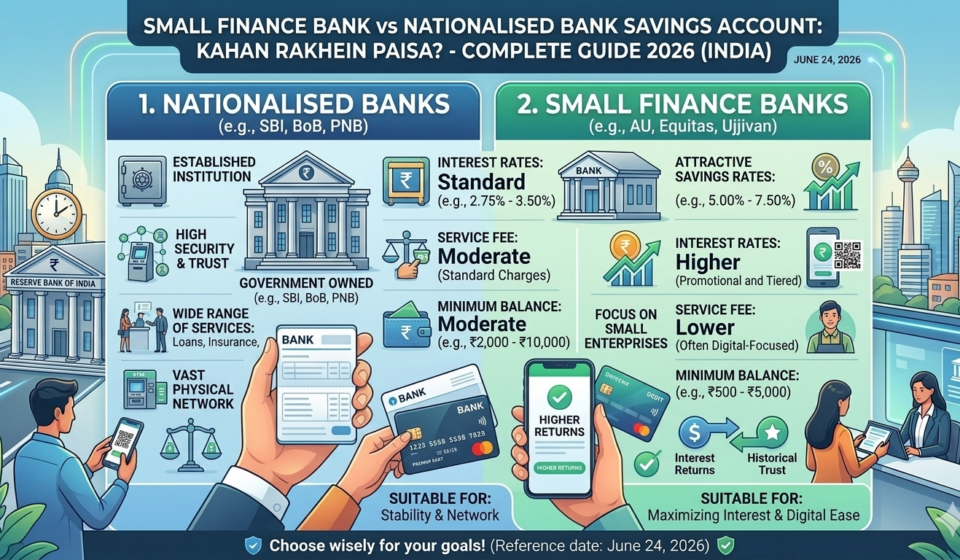
2026 mein ye question aur bhi important ho gaya hai kyunki Small Finance Banks (SFBs) 6%–8%+ tak savings account interest offer kar rahe hain, jabki SBI, PNB, Bank of Baroda aur Canara Bank jaise nationalized banks aam taur par 2.7%–3.5% ke aas-paas interest dete hain.
Lekin sirf interest rate dekhkar decision lena sahi nahi hota. Safety, branch network, customer service, ATM availability, digital banking aur liquidity bhi equally important factors hain.
Is guide mein hum detail mein compare karenge ki Small Finance Bank vs Nationalized Bank Savings Account mein paisa rakhna kis situation mein better hai.
What is a Small Finance Bank?
Small Finance Banks (SFBs) RBI-regulated banks hote hain jo financial inclusion ko promote karne ke liye establish kiye gaye hain.
Popular Small Finance Banks:
- AU Small Finance Bank
- Equitas Small Finance Bank
- Ujjivan Small Finance Bank
- Jana Small Finance Bank
- Suryoday Small Finance Bank
- ESAF Small Finance Bank
- Utkarsh Small Finance Bank
Inka main attraction hota hai:
- Higher interest rates
- Better FD rates
- Digital account opening
- Modern banking experience
What is a Nationalized Bank?
Nationalized Banks wo banks hote hain jinmein majority ownership Government of India ke paas hoti hai.
Popular Nationalized Banks:
- State Bank of India (SBI)
- Punjab National Bank (PNB)
- Bank of Baroda
- Canara Bank
- Union Bank of India
- Indian Bank
- Central Bank of India
- Bank of Maharashtra
In banks ki biggest strength hoti hai:
- Government ownership
- Large branch network
- Strong public trust
- Rural reach
Why Do People Search for “Small Finance Bank vs Nationalized Bank Savings Account”?
People usually compare them because of:
Higher Interest Rates
SFBs often provide much better returns.
Safety Concerns
People want to know where money is safer.
Emergency Fund Storage
Investors seek liquidity and accessibility.
Better Banking Experience
Many users prefer digital-first banks.
Long-Term Savings
Customers want the best balance between return and safety.
Interest Rate Comparison 2026
| Bank Type | Typical Savings Interest Rate |
| SBI | 2.70% |
| PNB | 2.70%–3.00% |
| Bank of Baroda | 2.75%–3.00% |
| Canara Bank | 2.90%–3.00% |
| Small Finance Banks | 5%–8%+ |
Example
If you keep ₹5 lakh for one year:
| Bank Type | Interest Rate | Approx Annual Interest |
| SBI | 2.70% | ₹13,500 |
| SFB (7%) | 7.00% | ₹35,000 |
Difference:
₹21,500 extra per year
This is why many savers are shifting part of their funds to Small Finance Banks.
How to Choose Between Small Finance Bank and Nationalized Bank
1. Identify Your Purpose
Ask yourself:
- Daily banking?
- Salary account?
- Emergency fund?
- Long-term savings?
The answer determines the best choice.
2. Consider Safety Requirements
If peace of mind is your top priority, nationalized banks often feel more comfortable to many customers because of government ownership.
3. Evaluate Interest Rates
For maximizing returns, Small Finance Banks usually win.
4. Official Website/App Method
Before opening any account:
- Verify latest interest rates
- Check account charges
- Review ATM network
- Read terms and conditions
Always use official bank channels.
Features and Services Available
Feature 1: Savings Interest
Small Finance Banks
Higher rates.
Nationalized Banks
Lower rates.
Winner: Small Finance Banks
Feature 2: Branch Network
Small Finance Banks
Limited branches.
Nationalized Banks
Thousands of branches across India.
Winner: Nationalized Banks
Feature 3: ATM Accessibility
Small Finance Banks
Moderate network.
Nationalized Banks
Extensive ATM presence.
Winner: Nationalized Banks
Feature 4: Digital Banking
Small Finance Banks
Often very modern and user-friendly.
Nationalized Banks
Improving rapidly but varies by bank.
Winner: Slight Edge to Small Finance Banks
Feature 5: Customer Trust
Small Finance Banks
Growing trust.
Nationalized Banks
Decades of established reputation.
Winner: Nationalized Banks
Safety: Is Small Finance Bank Safe?
This is the most important question.
RBI Regulation
Small Finance Banks are licensed and regulated by RBI.
Deposit Insurance
Both Small Finance Banks and Nationalized Banks are covered under deposit insurance up to:
₹5 lakh per depositor per bank
through the deposit insurance framework.
This means if you have:
- ₹3 lakh in Bank A
- ₹4 lakh in Bank B
both remain within insured limits separately.
Limits, Eligibility, or Requirements
Requirements are similar for both bank types.
Documents Required
- Aadhaar Card
- PAN Card
- Mobile Number
- Address Proof
Eligibility
- Indian residents
- Adults above 18 years
- Minors through guardian accounts
Charges, Fees, or Costs
Before opening an account, compare:
Minimum Balance Charges
Can vary significantly.
Debit Card Fees
May differ across banks.
ATM Charges
Check free transaction limits.
SMS Charges
Applicable as per regulations.
Account Closure Charges
Review before opening.
Types of Customers and Best Choice
Type 1: Salary Employee
Best Option
Nationalized Bank or major private bank.
Reason:
- Salary credit convenience
- ATM availability
- Branch access
Type 2: Emergency Fund Holder
Best Option
Combination of both.
Example:
- ₹2 lakh in SBI
- ₹3 lakh in AU Small Finance Bank
Type 3: Retired Person
Best Option
Nationalized Bank
Reason:
- Trust
- Branch support
- Familiar banking environment
Type 4: Return-Seeking Saver
Best Option
Small Finance Bank
Reason:
- Higher interest earnings
Benefits of Small Finance Bank Savings Accounts
Benefit 1
Higher savings account interest.
Benefit 2
Better FD rates.
Benefit 3
Modern digital banking.
Benefit 4
Fast account opening.
Benefit 5
Higher returns on idle cash.
Benefits of Nationalized Bank Savings Accounts
Benefit 1
Extensive branch network.
Benefit 2
Strong public confidence.
Benefit 3
Government ownership.
Benefit 4
Excellent rural presence.
Benefit 5
Wide ATM availability.
Safety Tips and Best Practices
Don’t Chase Interest Alone
Safety and convenience matter too.
Diversify Funds
Avoid keeping all savings in one bank.
Maintain Emergency Liquidity
Keep easily accessible funds.
Enable Banking Alerts
Monitor transactions.
Review Interest Rates Regularly
Banks can revise rates.
Common Problems and Solutions
Problem 1: Low Interest Earnings
Solution: Shift surplus funds to a higher-interest bank.
Problem 2: Limited Branch Access
Solution: Use nationalized banks for primary banking.
Problem 3: ATM Availability Issues
Solution: Check ATM network before opening.
Problem 4: High Charges
Solution: Compare account schedules carefully.
Problem 5: Multiple Accounts Management
Solution: Use one primary and one secondary account.
What to Do If Something Goes Wrong?
Step 1
Contact customer support.
Step 2
Raise complaint through internet banking.
Step 3
Visit nearest branch.
Step 4
Escalate through grievance channels.
Step 5
Maintain transaction records.
Step 6
Follow RBI complaint procedures if necessary.
Small Finance Bank vs Nationalized Bank Savings Account
| Feature | Small Finance Bank | Nationalized Bank |
| Interest Rate | Higher | Lower |
| Branch Network | Limited | Extensive |
| ATM Network | Moderate | Large |
| Digital Banking | Excellent | Good |
| Government Ownership | No | Yes |
| Customer Trust | Growing | Very High |
| Rural Reach | Limited | Excellent |
| Emergency Access | Good | Excellent |
Detailed Comparison
If your primary goal is earning the highest possible interest on savings, Small Finance Banks are usually the better choice.
If your priority is convenience, branch availability, trust, and long-term banking relationships, Nationalized Banks remain difficult to beat.
For most Indian savers, the smartest strategy is not choosing one over the other—but using both.
Practical Example
Suppose you have ₹10 lakh savings:
- ₹3 lakh in SBI (daily banking)
- ₹2 lakh in PNB (backup account)
- ₹5 lakh in a reputable Small Finance Bank (higher returns)
This approach balances:
- Safety
- Accessibility
- Higher earnings
Frequently Asked Questions (FAQs)
1. Kya Small Finance Bank safe hai?
Yes. Small Finance Banks are regulated by RBI and operate under banking regulations similar to other banks.
2. Kya SBI se Small Finance Bank better hai?
For interest rates, often yes. For branch network and accessibility, SBI generally remains stronger.
3. Emergency fund kahan rakhna chahiye?
A mix of nationalized banks and high-interest savings accounts is often a practical approach.
4. Small Finance Bank mein kitna paisa rakhna chahiye?
Many savers prefer keeping balances within the ₹5 lakh deposit insurance coverage per bank.
5. Kya Small Finance Bank mein UPI aur ATM milta hai?
Yes. Most Small Finance Banks provide UPI, ATM, debit cards, internet banking, and mobile banking.
6. Kis bank mein sabse zyada savings interest milta hai?
Small Finance Banks generally offer the highest savings account interest rates in India.
7. Long-term savings ke liye kaunsa better hai?
For maximum returns, Small Finance Banks are attractive. For convenience and accessibility, Nationalized Banks remain a strong choice.
Conclusion
The answer to “Small Finance Bank vs Nationalized Bank Savings Account: Kahan Rakhein Paisa?” depends on your priorities.
- Choose Nationalized Banks if you value trust, branch access, government ownership, and everyday banking convenience.
- Choose Small Finance Banks if your goal is to earn significantly higher interest on savings.
For most people in 2026, a hybrid strategy works best: use a Nationalized Bank such as SBI or PNB for regular banking needs and keep surplus funds in a reputed Small Finance Bank to earn higher returns.
This approach provides the best combination of safety, liquidity, convenience, and income from your savings.