
Zero Balance Savings Account 2026: Top 7 Banks in India (No Minimum Balance Required)

Introduction
Banking has become an essential part of everyday life in India. Whether you want to receive your salary, make UPI payments, save money, pay bills, or receive government benefits, having a savings account is almost a necessity. However, one common concern among account holders is the requirement to maintain a minimum balance.
Many traditional savings accounts require customers to keep a certain amount in their accounts. If the balance falls below the prescribed limit, banks may charge penalties. This is where zero balance savings accounts become extremely useful.
A zero balance savings account allows customers to enjoy banking services without maintaining a minimum balance. These accounts are especially beneficial for students, freelancers, low-income earners, senior citizens, homemakers, and first-time bank customers.
As digital banking continues to expand in 2026, more Indians are searching for “Zero Balance Savings Account 2026: Top 7 Banks in India — No Minimum Balance Required” to find the best banking option that offers convenience, security, and flexibility without additional maintenance costs.
This guide covers everything you need to know about zero balance savings accounts, including the top banks, features, eligibility, charges, benefits, and how to choose the best account for your needs.
What is Zero Balance Savings Account 2026: Top 7 Banks in India — No Minimum Balance Required?
A zero balance savings account is a type of bank account that does not require customers to maintain a minimum account balance.
Unlike regular savings accounts, where penalties may be charged for maintaining a low balance, zero balance accounts remain active regardless of the account balance.
Customers can still access:
- ATM withdrawals
- UPI transactions
- Mobile banking
- Internet banking
- Debit cards
- Fund transfers
- Government subsidy credits
- Direct benefit transfers
without worrying about minimum balance penalties.
Why Do People Search for “Zero Balance Savings Account 2026: Top 7 Banks in India — No Minimum Balance Required”?
There are several reasons behind the growing popularity of zero balance accounts.
No Minimum Balance Requirement
Customers do not need to keep money locked in their accounts.
No Penalty Charges
Avoid charges for falling below minimum balance requirements.
Easy Banking Access
Suitable for students and individuals with irregular income.
Digital Banking Convenience
Most zero balance accounts support modern banking features.
Financial Inclusion
These accounts help bring more people into the formal banking system.
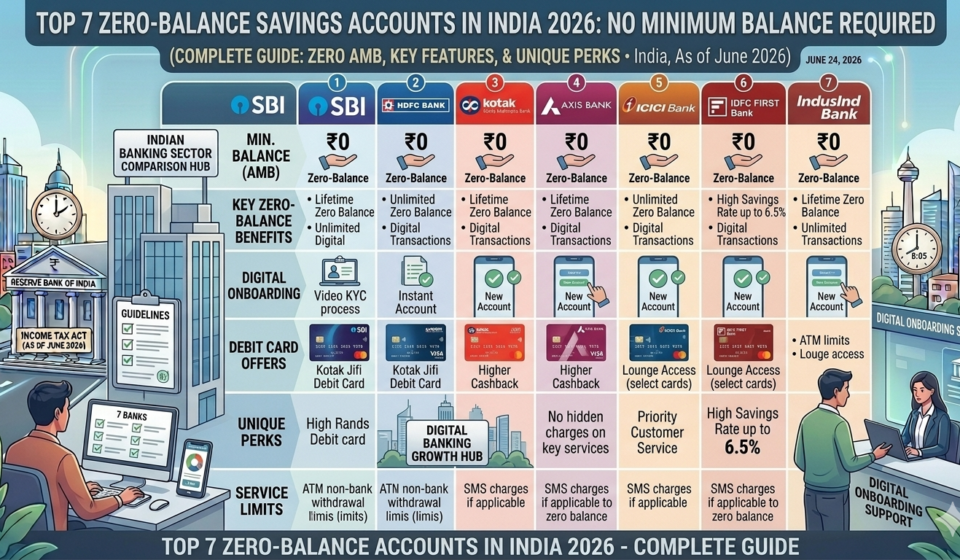
Top 7 Zero Balance Savings Accounts in India 2026
1. SBI Basic Savings Bank Deposit Account (BSBDA)
The State Bank of India’s BSBDA remains one of the most popular zero balance accounts in India.
Key Features
- No minimum balance
- Free RuPay debit card
- Mobile banking access
- Internet banking
- UPI support
- Large ATM network
Best For
- Students
- Rural users
- Government benefit recipients
2. Kotak 811 Digital Savings Account
Kotak 811 continues to be one of India’s leading digital savings accounts.
Key Features
- Fully digital account opening
- No minimum balance
- Virtual debit card
- Mobile banking
- UPI services
Best For
- Young professionals
- Digital banking users
3. HDFC Bank Basic Savings Bank Deposit Account
HDFC offers a reliable zero balance account with premium digital banking features.
Key Features
- Zero balance requirement
- Debit card facility
- Internet banking
- Mobile banking
- Easy fund transfers
Best For
- Urban customers
- Salaried employees
4. ICICI Bank Basic Savings Account
ICICI Bank provides a feature-rich zero balance banking experience.
Key Features
- Online account management
- UPI support
- Mobile banking
- Debit card
- Digital services
Best For
- Online banking users
- Tech-savvy customers
5. Bank of Baroda B3 Silver Account
Bank of Baroda offers a simple and accessible zero balance account.
Key Features
- No minimum balance
- Debit card
- Mobile banking
- Fund transfer services
- Nationwide branch network
Best For
- General banking users
- Semi-urban customers
6. Punjab National Bank Basic Savings Account
PNB remains a trusted option for customers seeking zero balance banking.
Key Features
- No minimum balance
- Debit card access
- UPI support
- Internet banking
- Wide branch presence
Best For
- Existing PNB customers
- Rural account holders
7. IndusInd Bank Indus Delite Savings Account
IndusInd offers modern banking features with attractive benefits.
Key Features
- Zero balance option
- Digital account opening
- Mobile banking
- Debit card benefits
- Online transactions
Best For
- Working professionals
- Digital banking customers
How to Find/Use Zero Balance Savings Account in 2026
1. Visit a Bank Branch
The traditional method remains popular.
Steps:
- Visit the nearest branch.
- Carry Aadhaar and PAN.
- Fill account opening form.
- Submit documents.
- Complete verification.
2. Open Through Mobile Banking App
Many banks now offer instant digital onboarding.
Steps:
- Download official banking app.
- Select savings account option.
- Choose zero balance account.
- Verify Aadhaar and PAN.
- Complete Video KYC.
3. Apply Through Official Website
Most banks support online account opening.
Steps:
- Visit bank website.
- Select savings account.
- Complete application.
- Upload documents.
- Finish KYC verification.
4. Official Website/App Method
This is the fastest method in 2026.
Advantages:
- Paperless process
- Quick approval
- Instant account activation
- Mobile banking access
Features and Services Available
Feature 1: UPI Transactions
Customers can send and receive money instantly.
Feature 2: ATM and Debit Card Access
Most banks provide debit cards for withdrawals and purchases.
Feature 3: Mobile Banking
Manage accounts from anywhere using smartphones.
Feature 4: Internet Banking
Access account information and transfer funds online.
Feature 5: Direct Benefit Transfers
Government schemes can credit funds directly into these accounts.
Limits, Eligibility, or Requirements
Eligibility typically includes:
- Indian resident
- Valid Aadhaar card
- PAN card or Form 60
- Mobile number
- Address proof
Certain banks may impose transaction limits based on account category and KYC status.
Charges, Fees, or Costs
Although there is no minimum balance requirement, some charges may still apply.
Possible Charges
- Additional ATM withdrawals
- Debit card replacement
- Extra cheque books
- Duplicate account statements
- SMS service charges (where applicable)
Most basic banking services remain free.
Types of Zero Balance Savings Accounts
Type 1: Basic Savings Bank Deposit Account (BSBDA)
Designed for financial inclusion and essential banking services.
Type 2: Digital Savings Account
Opened completely online through mobile apps or websites.
Type 3: Student Savings Account
Specially designed for students and young account holders.
Type 4: Salary Zero Balance Account
Provided through employer banking partnerships.
Benefits of Zero Balance Savings Account
Benefit 1: No Minimum Balance Requirement
No need to maintain a fixed balance.
Benefit 2: Cost Savings
Avoid penalties associated with low balances.
Benefit 3: Easy Accessibility
Suitable for all income groups.
Benefit 4: Digital Banking Features
Access modern banking services without extra costs.
Benefit 5: Financial Inclusion
Helps more individuals participate in the formal banking system.
Safety Tips and Best Practices
Follow these tips to protect your account:
- Never share OTPs.
- Keep debit card PIN confidential.
- Use strong passwords.
- Enable transaction alerts.
- Download only official banking apps.
- Avoid public Wi-Fi for banking transactions.
- Report suspicious activity immediately.
Common Problems and Solutions
Problem 1: Debit Card Not Received
Solution: Contact customer support or visit the branch.
Problem 2: Mobile Banking Registration Failed
Solution: Verify mobile number linkage and KYC status.
Problem 3: UPI Activation Issue
Solution: Re-register bank account in the UPI application.
Problem 4: KYC Pending
Solution: Complete Aadhaar or Video KYC verification.
Problem 5: ATM Withdrawal Failure
Solution: Check account balance and contact the bank if funds are debited.
What to Do If Something Goes Wrong?
Step 1
Review account activity through mobile banking.
Step 2
Check SMS and email notifications.
Step 3
Contact customer support.
Step 4
Visit your nearest branch.
Step 5
Raise a formal complaint.
Step 6
Escalate unresolved issues through the bank’s grievance redressal mechanism.
Zero Balance Savings Account vs Regular Savings Account
| Feature | Zero Balance Savings Account | Regular Savings Account |
| Minimum Balance Required | No | Usually Yes |
| Low Balance Penalty | No | Yes |
| Debit Card Facility | Yes | Yes |
| Mobile Banking | Yes | Yes |
| UPI Access | Yes | Yes |
| Internet Banking | Yes | Yes |
| Direct Benefit Transfers | Yes | Yes |
| Best For | Beginners & Low-Balance Users | Regular Banking Customers |
Detailed Comparison
Zero balance accounts are ideal for customers who do not want the burden of maintaining a specific balance. They provide access to most essential banking services without penalty risks.
Regular savings accounts may offer premium features and higher transaction limits but often require maintaining a minimum balance.
For students, freelancers, and first-time account holders, zero balance accounts are often the better choice.
Frequently Asked Questions (FAQs)
1. Which is the best zero balance savings account in India in 2026?
SBI BSBDA, Kotak 811, HDFC Basic Savings Account, and ICICI Basic Savings Account are among the most popular options.
2. Can I open a zero balance account online?
Yes. Most leading banks offer online account opening with Aadhaar-based verification and Video KYC.
3. Do zero balance accounts provide ATM cards?
Yes. Most banks issue debit cards or ATM cards with these accounts.
4. Is PAN mandatory for opening a zero balance account?
Generally yes, although Form 60 may be accepted in specific cases according to banking regulations.
5. Can I receive salary payments in a zero balance account?
Many zero balance accounts can receive salary credits, government benefits, and fund transfers.
6. Are there hidden charges?
There are usually no minimum balance penalties, but charges may apply for optional services such as extra ATM transactions or card replacement.
7. Is UPI available with zero balance accounts?
Yes. Most zero balance accounts support UPI payments and fund transfers.
Conclusion
Choosing the right Zero Balance Savings Account 2026: Top 7 Banks in India — No Minimum Balance Required can help you enjoy convenient banking without worrying about minimum balance requirements or penalty charges.
Among the leading options, SBI BSBDA, Kotak 811, HDFC Basic Savings Account, ICICI Basic Savings Account, Bank of Baroda B3 Silver Account, Punjab National Bank Basic Savings Account, and IndusInd Delite Savings Account offer excellent combinations of accessibility, digital banking features, and customer-friendly services.
Before opening an account, compare eligibility requirements, transaction limits, ATM facilities, debit card benefits, and digital banking features. Choose the account that aligns with your financial needs and banking habits.
For students, freelancers, salaried employees, and first-time bank customers, a zero balance savings account remains one of the smartest and most affordable banking choices available in India in 2026.