
Joint Savings Account Kya Hota Hai? Fayde, Nuksaan Aur Kaise Open Karein – Complete Guide 2026 (India)

Introduction
Banking needs often extend beyond individual account ownership. Married couples manage household expenses together, parents save for their children’s future, business partners handle shared finances, and family members may want convenient access to a common pool of funds. In such situations, a Joint Savings Account can be a practical solution.
A Joint Savings Account allows two or more individuals to operate a single savings account together. It offers convenience, transparency, and easier financial management for shared expenses and goals. However, like any financial product, it also comes with certain risks and limitations that account holders should understand before opening one.
Many Indians search for “Joint Savings Account Kya Hota Hai? Fayde, Nuksaan Aur Kaise Open Karein” to learn whether a joint account is suitable for their needs and how the account opening process works.
This comprehensive guide explains everything about Joint Savings Accounts in India, including their features, benefits, disadvantages, eligibility, account opening process, tax considerations, and best practices.
What is a Joint Savings Account?
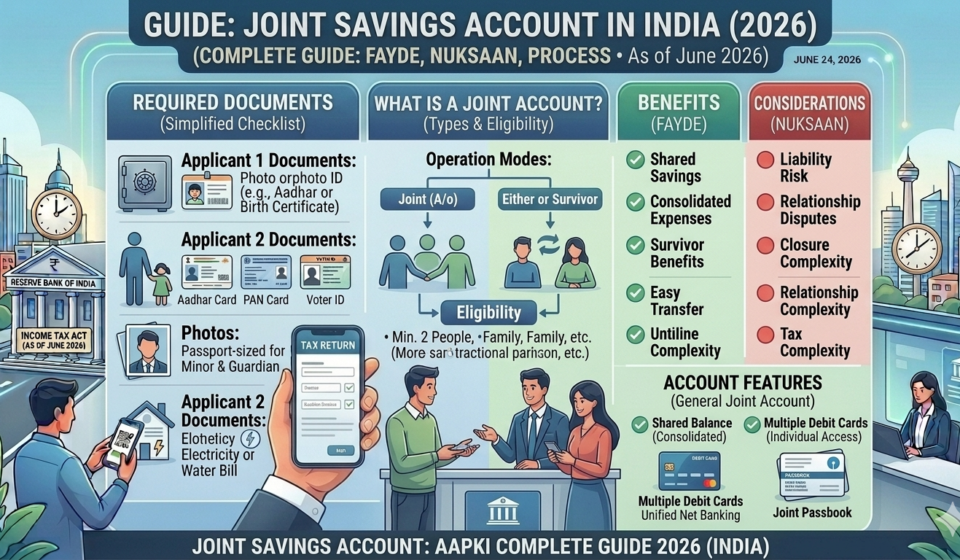
A Joint Savings Account is a savings account that is owned and operated by two or more individuals.
Unlike a regular savings account that belongs to one person, a joint account allows multiple account holders to access and manage the funds according to the operating instructions chosen at the time of account opening.
Common joint account combinations include:
- Husband and wife
- Parent and child
- Siblings
- Business partners
- Family members
The account holders share ownership of the funds deposited in the account.
Why Do People Search for “Joint Savings Account Kya Hota Hai? Fayde, Nuksaan Aur Kaise Open Karein”?
People usually consider joint accounts for several reasons.
Shared Household Expenses
Couples can manage monthly expenses more efficiently.
Family Financial Planning
Parents and children can jointly manage savings.
Emergency Access
Another account holder can access funds if one person is unavailable.
Transparency
All account holders can view account activity.
Convenience
Managing common expenses becomes easier.
How Does a Joint Savings Account Work?
When a joint account is opened, the bank records multiple account holders under one account number.
Depending on the operating mode selected, one or more account holders may be authorized to operate the account.
Examples:
- Either or Survivor
- Jointly
- Former or Survivor
- Anyone or Survivor
The chosen operating instruction determines how transactions can be carried out.
Types of Joint Savings Accounts
Type 1: Either or Survivor
This is the most popular option.
How It Works
Either account holder can:
- Withdraw money
- Transfer funds
- Use banking services
If one account holder passes away, the surviving holder can continue operating the account.
Best For
- Married couples
- Family members
Type 2: Jointly
All account holders must approve transactions.
How It Works
Signatures or authorization from all holders are required.
Best For
- Business partners
- Shared investments
Type 3: Former or Survivor
The primary account holder controls the account during their lifetime.
The secondary holder gains access after the primary holder’s death.
Best For
- Parent-child accounts
- Estate planning
Type 4: Anyone or Survivor
Applicable where multiple account holders exist.
Any one holder can operate the account.
Best For
- Large families
- Group financial management
How to Open a Joint Savings Account in 2026
1. Visit a Bank Branch
Most banks allow joint account opening through branch visits.
Steps
- Choose the bank.
- Visit the branch.
- Request a joint account opening form.
- Select operating mode.
- Submit documents.
- Complete verification.
- Receive account details.
2. Convert Existing Account into Joint Account
Some banks allow existing individual accounts to be converted into joint accounts.
Steps
- Submit request.
- Add second account holder.
- Complete KYC.
- Obtain approval.
Bank policies may vary.
3. Online Application Method
Several banks provide online application facilities.
Steps
- Visit official bank website.
- Select savings account.
- Choose joint account option.
- Upload documents.
- Complete Video KYC if available.
4. Official Website/App Method
Digital onboarding offers:
- Faster processing
- Paperless documentation
- Easy application tracking
However, some banks may still require branch verification.
Documents Required
Typically, all account holders must provide:
Identity Proof
- Aadhaar Card
- Passport
- Voter ID
- Driving Licence
PAN Card
Required for banking and tax compliance.
Address Proof
- Aadhaar
- Utility bill
- Passport
Photographs
Recent passport-size photographs.
Features and Services Available
Feature 1: ATM and Debit Card Access
Banks usually issue debit cards to account holders.
Feature 2: Mobile Banking
Account holders can monitor transactions through mobile banking.
Feature 3: Internet Banking
Online account access and fund transfers.
Feature 4: UPI Services
UPI registration is generally available according to bank policies.
Feature 5: Nomination Facility
Customers can appoint nominees for easier claim settlement.
Benefits of a Joint Savings Account
Benefit 1: Shared Financial Management
Couples and family members can manage money together.
Example
Household expenses can be paid from a common account.
Benefit 2: Easy Access to Funds
Multiple account holders can access funds when needed.
Benefit 3: Better Transparency
All account holders can track transactions.
Benefit 4: Emergency Convenience
If one holder is unavailable, another can operate the account.
Benefit 5: Simplified Goal-Based Savings
Useful for:
- Home purchase
- Education planning
- Family vacations
- Emergency funds
Disadvantages of a Joint Savings Account
Nuksaan 1: Reduced Privacy
All account holders can see transactions.
Nuksaan 2: Potential Disputes
Disagreements regarding spending may arise.
Nuksaan 3: Shared Responsibility
All holders are responsible for account activities.
Nuksaan 4: Operational Restrictions
Jointly operated accounts may require multiple approvals.
Nuksaan 5: Complicated Ownership Questions
Disputes can occur if ownership expectations are unclear.
Limits, Eligibility, or Requirements
Generally, applicants must:
Be Eligible Residents
Indian residents can open joint savings accounts.
Complete KYC
All holders must complete KYC formalities.
Meet Age Requirements
Adults can open accounts independently.
Minors may require guardians.
Maintain Required Balance
Depending on account type and bank rules.
Charges, Fees, or Costs
Charges are generally similar to regular savings accounts.
Possible Charges
- Minimum balance penalties
- Debit card fees
- Additional ATM transactions
- Cheque book charges
- SMS alert charges
Always review the bank’s latest schedule of charges.
Safety Tips and Best Practices
Clearly Define Purpose
Decide why the account is being opened.
Choose Correct Operating Mode
Select an operating instruction suitable for your needs.
Monitor Transactions Regularly
Review account statements frequently.
Enable Alerts
SMS and email notifications improve security.
Keep KYC Updated
Ensure all account holder information remains current.
Common Problems and Solutions
Problem 1: Disagreement Between Account Holders
Solution: Establish clear rules before opening the account.
Problem 2: Transaction Approval Delays
Solution: Choose “Either or Survivor” if flexibility is important.
Problem 3: Forgotten Login Credentials
Solution: Reset through official banking channels.
Problem 4: KYC Issues
Solution: Update documentation promptly.
Problem 5: Nominee Not Added
Solution: Submit nomination request immediately.
What to Do If Something Goes Wrong?
Step 1
Review transaction records.
Step 2
Discuss concerns with co-account holder.
Step 3
Contact bank customer support.
Step 4
Visit branch if necessary.
Step 5
Update operating instructions if permitted.
Step 6
Escalate unresolved issues through grievance channels.
Joint Savings Account vs Individual Savings Account
| Feature | Joint Savings Account | Individual Savings Account |
| Number of Holders | Two or More | One |
| Shared Access | Yes | No |
| Transparency | High | Private |
| Emergency Access | Better | Limited |
| Decision Making | Shared | Individual |
| Suitable for Families | Excellent | Moderate |
| Suitable for Personal Savings | Moderate | Excellent |
Detailed Comparison
A Joint Savings Account is ideal for people who share financial responsibilities and want convenient access to common funds.
An Individual Savings Account is generally better for personal savings, privacy, and independent financial management.
Many couples and families choose to maintain both a joint account for shared expenses and separate individual accounts for personal financial needs.
Frequently Asked Questions (FAQs)
1. Joint Savings Account kya hota hai?
A Joint Savings Account is a bank account owned and operated by two or more individuals.
2. Husband aur wife joint account open kar sakte hain?
Yes. Married couples are among the most common joint account holders.
3. Joint account mein ATM card milta hai?
Yes. Most banks provide debit cards according to their policies.
4. Joint account online open kar sakte hain?
Many banks offer online application facilities, although verification requirements may vary.
5. Joint account ke liye PAN aur Aadhaar zaroori hai?
Generally yes. All account holders usually need to complete KYC requirements.
6. Joint account mein nominee add kar sakte hain?
Yes. Most banks provide nomination facilities.
7. Joint account ka best operating mode kaunsa hai?
For most couples and families, “Either or Survivor” is often the most convenient option.
Conclusion
A Joint Savings Account can be an excellent banking solution for couples, families, and individuals who share financial responsibilities. It offers convenience, transparency, emergency access, and simplified management of common expenses.
However, before opening a joint account, it is important to understand the operating mode, ownership implications, and potential disadvantages such as reduced privacy and possible disagreements.
For most married couples and family members, the Either or Survivor option provides the best balance of convenience and flexibility. At the same time, maintaining separate personal accounts alongside a joint account can help preserve financial independence.
By choosing the right bank, selecting the appropriate operating instructions, and following sound financial practices, a Joint Savings Account can become a valuable tool for managing shared finances efficiently in 2026 and beyond.